I spent New Year’s Eve much the way I spend most evenings these days: teaching children (and occasionally adults) to pilot ponies. In addition to my freelance clients (most of whom, mercifully, can steer), I herd cats (by which I mean the beginner students, whose steering is hit or miss) at two different lesson barns. You know. It’s a living.
Being as it was New Year’s Eve, I had a fair number of no-shows, and I ended up heading home a little earlier than planned. I was scanning Sirius XM radio channels as I drove, and most of them seemed to be observing the year’s end by cranking up various flavours of party tunes — 70s on one channel, polka (aren’t all polkas party tunes? — asking for a friend) on another, Death Metal par-tay, Broadway party, all Phish All The Time dance tunes. Hey, there are something like 300 channels on the damn service…
And as certain holidays are structured explicitly to make you feel like a ratshit loser if you’re alone (see also: Valentine’s Day), I was mostly thinking as I channel-surfed, that I really miss dancing.
I think the last time I danced for any length of time was at a friend’s wedding in Bermuda, some seven or eight years ago. And by dancing, I’m talking a good DJ, a decent sized dancefloor, stiletto heels that flay six layers of epidermis right off your feet but you don’t care, and getting a really nice and probably sparkly outfit indecently sweaty. Having just enough alcohol in your system to lower your inhibitions a smidge, yet not impact your coordination, is important (as mentioned previously, I’m a cheap date, so one Screwdriver is generally sufficient). As is music that washes over you, thuds pleasantly through your nervous system and your bone marrow, is a fair bit too loud, and is so familiar that you can sing along until you are too out of breath to do so.
One of the likely reasons I haven’t danced in years is that the music seems to have moved on without me. I have limited enthusiasm for what’s currently offered in most clubs, which is mostly an unrelenting beat that goes on for hours at a time, minus lyrics or bridges or anything sans AutoTune. (I loathe AutoTune with the white-hot intensity of a thousand suns. I mean, if you need this thing because you can’t carry a tune, why the fuck are you even calling yourself a singer?) I’m outing myself on the creeping decrepitude thing by admitting that I’d rather dance to what is probably now considered ‘oldies’ (does that include the 90s, I wonder?). And short of weddings, DJs who’ll spin that sort of thing are the exception rather than the rule. If you encounter such a DJ, you probably also have to suffer the fucking Chicken Dance and the Hokey Fuckity Pokey. Quite a price to pay if you ask me.
I also have a long-standing phobia about being the oldest person in a club, something that has been a problem since sometime back in the previous century. In addition, it’s hard (though not impossible – see: lowering inhibitions, above) to engage fully with the music on a solo basis … much easier with an enthusiastic dance partner. And we all know how accessible those are if you’re of a hetero persuasion.
Like so many white dudes, my Ex pretty much refused to dance with me. Talk about sucking the joy right out of the room. Back in my 30s, when I lived in Bermuda for a year, I used to go clubbing at least two or three nights a week. There was a place called the Oasis, in downtown Hamilton, which had two rooms, one of which usually placed electronic music and the other of which played 80s and 90s rock (more to my taste even then). It would get cranked up about 10:30 or 11 at night, go till 2:30 a.m., and then after last call pretty much everyone on the island would spill out of there and head to the Ice Queen, which was open till stupid o’clock, for a cone. How wholesome is that? I remember rows of happily disheveled people of all sexes, with makeup half-melted off their faces, sitting on the curbs and slurping soft-serve while the tree frogs chorused from just beyond the parking lot. (Mind you there have been a couple of shootings there over the years. Not everyone emerged from Oasis as sober as I usually was.)
The actual Ice Queen, earlier. Or later, actually, since this was probably taken sometime AFTER 1995.
So. No dancing this New Years’ Eve, unless you count a few minutes of horribly undignified booty dancing in my truck, to Earth, Wind and Fire’s “Shining Star” (thanks, 70s Rewind channel’s “Cassette Era” dance party). I may still have some moves, but you should be grateful you didn’t see that.
I’d just like to say: Piss off, 2021, and don’t let the door hit you in the booty on your way out.
And also, there was the abrupt end of a teaching job I loved (even if it gave me massive intestinal upset, no time or energy to ride my horses, and eventually ran my poor old truck into the ground). I’m still incandescently furious about it. I was bloody good, dammit, and Ridgetown College, in its infinite wisdom, had the temerity to suggest that because I had not managed to relocate to a farm in the hinterlands of Huron County, that I somehow lacked commitment to a contract job which was never going to commit to me.
Dunno … I think commuting two hours each way on a daily basis for eight months demonstrates some level of commitment. Without even pointing out that a good four months of that were in the hellish depths of winter, when it was rarely just two hours each way. I drove through some storms that a bloody herd of magical musk-oxen would not have gotten through. Seriously, I still get night terrors about white-knuckle driving on endless stretches of white-outs.
It ain’t a view from the Millenium Falcon, my friend.
Suffice to say, I busted my ass for that job, for those kids, for that Equine Care and Management program, and only now, two years on, can I make myself write even this bit of bitter vitriol about it. But hey, I am at least in possession of some killer Powerpoint lectures about equine nutrition, stable management, conformation, equine behaviour … and how to write a resume <insert uber-ironic eyeroll here>. You know. If anyone’s interested.
So also, there was the Landlord From Hell. Who had been an LFH pretty much from Day One, but went nuclear on me when he ignored all the public health recommendations at the beginning of the pandemic and moved onto the farm I was renting. Previous to Covid, he had treated the place like a cottage and had only turned up two or three weekends a year. He would wreak a little random havoc and then fuck off again for a few months. Once installed full-time, he decided he didn’t want a tenant anymore — but having no legal basis to evict me, decided to just make my life a vortex of terror, hostility, and fear until I left. Essentially, I’ve felt under siege for a year and a half — and without going into too much detail (because you bet your ass I am pursuing legal action against him) — I have not felt safe, nor felt that my horses were safe. (And yes, I was in contact with law enforcement on several occasions, and they were beyond useless. Sadly, I would not recommend that anyone in a precarious living situation put their faith in the Ontario Provincial Police.)
Basically humans suck, and I have a rare and exemplary talent for finding the ones who suck the worst.
On the up side, hiding in my little shoebox of a house and not doing terribly much in the way of working thanks to Covid lockdowns, I got my ass on my treadmill and managed to (slowly and laboriously) lose 20 pounds. I have also (so far) failed to contract Covid. I’ve only really had one confirmed exposure/test incident, back last December, and I was negative. I’m now fully vaxxed, and grateful both for that and for having been able to live off the generosity of Justin Trudeau for the past 18 months while my income was next to bugger-all. Seriously, the feds in my country handled the pandemic pretty fucking well, all things considered, and after the past four years of watching insanity, lies, hatred, conspiracy theories, propaganda, and disaster reign in the US, anyone who finds anything significant to bitch about re: the Canadian government needs to give their fricking head a shake. Shut up and be grateful for the stability and safety you’ve got, you craven idiots.
So anyway. I managed, in August, to relocate my horses and myself, though my current situation is temporary and less than ideal in many respects. (Just tonight, my roommate blew up at me without warning because apparently she was unaware that cats shed. So that’s awesome …) It’s a port in a storm, and the larger problem of somewhere solid to live remains to be solved.
Dumpster fire, squared.
I do kind of wonder how the manufacturers of Christmas ornaments will top last year’s “2020 Dumpster Fire” rendered in blown glass and sparkles, for 2021. I am eager to see, even if the likelihood of my breaking out any ornaments this coming holiday season is next to zero, given that most of my belongings are in storage indefinitely. Because somewhere in the middle of my personal pandemic shitstorm, my Significant Other of 18 years decided I wasn’t worth the effort anymore.
When my landlord served me with a bunch of bogus eviction documents last December, among the falsehoods and threats contained therein was an utter fabrication about said SO having brandished a shotgun in the vicinity of my landlord. This never happened. It’s not just a fabrication, it’s a felony if it were true, which it categorically is not. So the accusation is serious, but utterly bogus because there is no police report to produce. But my SO took this accusation as the final proof that I am a hot mess and he no longer wanted to be involved. And so he basically cancelled Christmas and left me alone.
It was at this point that most of my friends started saying variations on, “I never really understood what you saw in him anyway.”
Do you even dressage in that thing??
The weird thing (well, one of the weird things) was that he didn’t see this as abandonment. Still doesn’t. Because, I guess, he still called me on occasion to see if I was alive … or more accurately, to rant about what a miserable time he was having at his job, and maintain that he was protecting me — by only calling once in a while — from how vexed it was making him. It was about as supportive as one of those laughably flimsy “yoga bras” that I see being sold in (seriously??) tack shops, of all places. Who are the women for whom these are appropriate garments for sitting trot? But I digress.
As far as he was concerned, we were still a Thing — whatever anemic, circling-the-drain version of Thing that might be. Me? After 18 years of being with a man who had always had one foot out the door (because see above, I am a liability and a Hot Mess, but I do come with several pairs of rather sexy footwear and I’m nice to his mother), somewhere along the line I got fucking sick and tired of disappointment. I finally called it quits after he refused to even consider for a fraction of a second, attending my parents’ 60th anniversary dinner, but wanted me to attend a family function of his. I was in the middle of moving (needless to say, with zero help from him) but made a herculean effort to be there for him. Christ alone knows why. We hadn’t seen each other in the flesh for at least eight weeks. When I arrived, he glared at me, said I was late and we needed to get on the road. That was my greeting. I blinked, and retreated to the loo, where I took several long, even breaths, and then I emerged and asked him whether he might want to re-think his greeting. He doubled down. And I knew I had finally, finally reached the limit I should have recognized years ago.
I left … but he left me first.
I only wish it was this cool.
So how do you miss someone who was never there? In 18 years together (for a given value of ‘together’), we never lived in the same building. Most of the time we weren’t even in the same area code. I had to be where my horses could be accommodated, and my SO had his little house that he inhabited sort of like a hermit crab. He never had any intention of committing to my lifestyle, and his certainly didn’t have any room for me. In fact, other than a dressing gown, there wasn’t even anything of mine to retrieve from his house, in the end. I stopped in one day in September, when I had to be in his town for a mammogram, and left him his key and a packet of Maltesers to soften the blow. Who the hell knows if it was actually a blow to him.
For over a decade, we talked every day — but I can count on one hand the number of times he was in a room with my parents. When it came to the stuff guys are useful for — helping fix a fence, change the oil in my truck, or getting something from the top shelf — he was 99.9% absent. When my aged cat, Moxie, disappeared (presumably to hide and die on her own), he mocked me for being devastated. He spent a lot of time criticizing his older brother for being emotionally stunted, but honestly, he wasn’t much better. And when he’s cruel, he’s bloody well surgical about it.
It’s easy to dump on an ex, of course. We were sympatico on a number of fairly important things, including Hawaiian pizza, Amanda Marshall, art galleries, and hating most televised sports. He gave me a few very nice gifts over the years, though his choices were heavily weighted towards electronics. (I do love my electric keyboard, and the pearls he begrudgingly bought me months after I ooh’ed and aah’ed over some in a store in Quebec City. He was usually crushingly dismissive of the gifts I gave him, always chosen with great effort and thought.) We’re both cheap dates, generally limiting ourselves to one glass of wine per evening — so I never had to deal with him drunk. But getting him to go anywhere or do anything was like pulling teeth. I was so very weary of the automatic ‘no’ that just sucked all the joy out of everything. Most activities I was interested in, I did alone — so nothing’s really changed there.
Would it kill you to go on a dirty weekend with me, just ONCE?
I naively once thought Marshall’s song, “Marry Me” would be our wedding song — yes, friends will be shocked that I even mentioned marriage and me in the same paragraph, but I really would not object to having a spouse who was actually invested in me. (Even if in my advanced state of decrepitude, I would be frankly ridiculous in a white dress.) I’m loyal AF (maybe that’s my problem), and I would like someone to invest my emotional energy in too. My SO squelched that when he admitted that his interpretation of the song’s final line, “So baby, if you’re free, marry me” was an indication that the whole song was just a come-on to someone who was cheating. Wait, what?
So here you go: the soundtrack of a failed relationship. Ugh. At least I’m accustomed to solo Xmases. My apologies for the pity party, gentle readers. I’ll be fine once we get past the fucking holidays. And how the hell have YOU been weathering the pandemic?
So short version: not dead yet. Have serious plans to revitalize the poor pathetic moribund blog, and the way things are going, I’ll have plenty of time in January to do so. (Sigh.) Meanwhile, however, have a lovely dash of snark.
Godey’s Lady’s Book and Magazine, March, 1866. Archive.org via WikiCommons.
“Women are already a bad cocktail unto themselves. Unchecked and untempered they’ll run feral and ruin the best of men, but you combine them with horses and John Freaking Wayne would have difficulty in taming them. I cannot pin it down, nor do I wish to expend the calories of energy to figure out why women have such a psychological attachment to horses, but they do.”
Aaron Clarey on MRA blog, Return of Kings.
Poor Aaron. A certain kind of man will forever be mystified by women, largely because he won’t listen to what they actually have to say. Nowhere is that clearer than in the centuries-old subgenre of Men Attempting To Explain Why Women Love Horses, which is busting with theories about phallic symbolism, misplaced maternal instinct and women basically being oversexed animals anyway. I wrote my first book,
Emily has a point. Even feminist-mindset women can fall into the trap of dismissing women’s voices, because society has taught us to. This is an interesting perspective on recipe blogs, from a writer/blogger I consistently enjoy.
I don’t know if those people have heard of cookbooks.
If you do not have an extensive cookbook collection, or if you can’t find what you are looking for in the books you do have, there are some really great sites that post reliable, well-tested recipes that you can either read about in detail or just go on to make. There are also community recipe sites where recipes are…
Can I just say: It’s not even a fucking Christmas song.
I kind of hate all Christmas music anyway. 99% of it is drivel that we would never be caught dead listening to at any other time of year. At best it has a lovely melody (O Holy Night comes to mind) but (atheist POV here) creepy or ridiculous lyrics that leave me conflicted; at worst, it’s trite, clichéd, and annoying AF. By December 25th, honestly, the thing I am most looking forward to is that the fucking music is gonna stop by the end of the day.
But there’s a song out there which has spawned controversy waaaay over and above that of a non-believer singing about the Messiah arriving via improbable virgin birth. And you know which one I’m talking about.
To those who continue to fuel the annual culture skirmish around the airing of “Baby, It’s Cold Outside” as a festive season staple, brace yourselves, because I’m taking the snowflake side.
And yes, I know. I know. It’s been blogged to death already and I should really just learn not to feed the trolls. I’ve waded in a couple of times on social media already and gotten bitch-slapped for it, but something in me just won’t let it go. At least here on my blog, almost no-one comments, so perhaps I can have the last word. (But hey, feel free to prove me wrong here. Go ahead. Comment.)
I will be blunt (yeah, when am I not?) when I say that personally, I find the song extremely date-rapey. Every single time I hear it, it creeps me the hell out.
And I will also be blunt in telling you that I, personally, have never been raped. That puts me in the minority among women, according to a2018 American study on sexual harassment and sexual assault.Have I come close? Yup. Very close. Have I been harassed, intimidated, threatened with violence, made to feel afraid of a man in my life? Yup, big time. Many times.
I am part of the 80% in that article above (if you haven’t clicked on it … do). And I suspect the other 20% are lying. (Women have many reasons to lie about it, by the way.)
Given that this is such a universal experience for women (which means it must be pretty universal behaviour for men, too, unfortunately), I don’t consider myself any more or less mentally healthy in the wake of those experiences, than my sistas. What I’m clumsily trying to say is that my visceral reaction to the song isn’t linked to any particular incident. It is not triggering for me to the extent that it brings on flashbacks or anything.
But I personally know more than one woman who has been raped. So do you. (And you don’t need to have been actually raped, to be triggered.)
I don’t need to actually reproduce the lyrics here, do I? You know which lines are problematic. (Most of them, really.) There’s the one suggesting the use of roofies (“Say, what’s in this drink?”). There’s all the ‘her mouth says no, no, but there’s yes, yes in her eyes’ bullshit, there’s the guy whining, “What’s the sense in hurting my pride?” and “How could you do this thing to me?” (it’s all about you, dude), and that’s to say nothing of the fact that half of her protests are about her mom and dad fretting at home, which leads me to ask — just how old is the female in this song? Do we have to add being a non-consenting minor to its extensive list of Extreme Squickiness??
So I am uncomfortably aware that if I feel squicky and unclean every time I hear this song, then I can easily imagine how it feels to someone whose mental health, in the wake of a horrifying experience, might be considerably more fragile than mine.
I just don’t find that thought particularly festive.
Even the luckiest of females has been in the position of having to gracefully extricate herself from a situation with some dude, which has turned threatening, uncomfortable, fucking creepy, or otherwise potentially unsafe. We’ve been trained to do it by the generations of women before us, by being conciliatory and non-confrontational rather than firm and no-nonsense. We try to escape with our dignity intact, and leave the door
The elephant may be significant here.
open to further interactions (I can’t help but think about this with a shiver of discomfort for the women who had the misfortune to interact with Jian Ghomeshiand then got strafed at his trial) while we’re getting the hell outta Dodge.
Now, before you say it. Yes, I am aware of thearguments that the song is a product of its time, when women couldn’t just simply say yes to sexual advances, when they had to be coy and play ‘hard to get’. And I understand that the lyrics can be interpreted as flirtation on both sides. I get it. I really, really do. But.
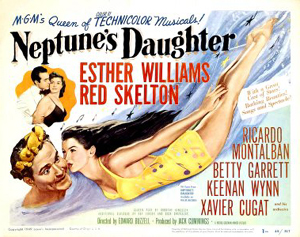
I’ve watched the two scenes in which the song is used, in the 1949 movie, Neptune’s Daughter. And I find it pretty squicky regardless of whether it’s Esther Williams fending off Ricardo Montalban, or the gender-bending version with Red Skelton and Betty Garrett. It’s serious dub-con (dubious consent) territory either way.
Is this me reacting with a set of 21st century, feminist attitudes towards gender interactions, sexual politics, and consent, heightened perhaps by the #MeToo movement? Undoubtedly. But then how would we know if anyone in the audience in 1949 was squirming uncomfortably? It’s not like women had the means or opportunity to voice that discomfort in any way, shape or form at the time.
In 2018, people have leapt to the defence of the song with such vehemence that I wonder what they’re hearing when they call the song ‘cute’ and ‘charming’. They’ve even explained away the roofies stuff by erroneously claiming it was written during Prohibition (it wasn’t) or that it was aprevailing joke of the timeto say, “What’s in this drink?” to excuse any sort of naughty behaviour. Not terribly convincing, IMHO.
I find it really irritating when people deflect from the problematic lyrics of Baby, It’s Cold Outside by pointing out other songs which are equally, or more ‘offensive’. The typical Facebook post in this vein runs along the lines of, “But what about (every rap song ever written)?” Yes, (every rap song ever written) is a misogynist dumpster fire. That’s irrelevant. I’m not forced to listen to any of it during the holiday season.
What’s worse than the deflecting, though, is the accusation that I have jumped on the bandwagon of People Who are Offended by Everything. How in hell could I possibly object to this delightful holiday classic? Why would I want to spoil (interesting word, that) a cherished holiday tradition? I must be a humourless, snowflake, femiNazi bitch to even bring it up. Can’t I see the woman in the song wants it?
Here’s the thing: there is a huge, huge gulf between being offended, and being triggered. I am not offended by Baby, It’s Cold Outside. (Those who know me, and those who have read this blog, know that there’s plenty of stuff I get pissed off about, but actually precious little that I’m offended by.) But I am triggered, and I know that many, many women are far more triggered than I am (holy shit, I have never used so many italics in one blog post before). To the point of being traumatized.
And on behalf of those women (and maybe some men too, who knows), I personally would like not to have to hear Baby, It’s Cold Outside on the radio every December, and I applaud the media outlets who have responded to that with sensitivity. I’m also happy to heap scorn upon thecowards who reversed that decision(I’m looking at you, CBC).
Those who have taken offense by my (supposedly) being offended have also argued that it’s ludicrous that the song was banned by humourless-femiNazi-bitches like me (it wasn’t banned — in every case, the media outlets chose voluntarily to withdraw the song from their playlists), and that if I don’t like it, I can always just change the station (I do, actually). My counter-argument: if so many people find the song anything but festive (and here I have to emphasize once again: it’s not even a Christmas song— it only mentions snow, not the holiday at all!), then why not spare them the squickiness and, if you enjoy the song, just play it for yourself in the comfort of your own home or car? Seems like a win-win to me.
There’s a now somewhat famous Tumblr post about Baby, It’s Cold Outside written by someone named teachingwithcoffee, which sums up the sexual politics of the song like this:
“So it’s not actually a song about rape – in fact it’s a song about a woman finding a way to exercise sexual agency in a patriarchal society designed to stop her from doing so. But it’s also, at the same time, one of the best illustrations of rape culture that pop culture has ever produced. It’s a song about a society where women aren’t allowed to say yes…which happens to mean it’s also a society where women don’t have a clear and unambiguous way to say no.”
The rage I feel at our lack of agency — both in the 1940s, when the song was written, and right now — is a bit inarticulate, frankly. The idea that women still cannot make straightforward choices about our sexuality without being hoist by our own petards is frankly ridiculous — and yet, here we are, still being judged as either frigid or sluts, depending on our answer to a proposition. If we say yes, without a whole bunch of token protests à la the song, then we’re nymphos, but if we say no we don’t really mean it and we’ll inevitably cave under pressure? Oh, wait, and then after we cave under pressure, men don’t respect us anymore. There’s just something utterly unpalatable about all of that patriarchal shit, and it makes me see red because, apparently, there’s a huge segment of the population which never wants to see that change.
Which means that, on some level, we still have very little understanding of consent, and very little willingness to give up the structure of male privilege.
I don’t know how much longer it’s going to take us to get to ‘no can actually mean no’. But the vigour with which people have defended this song seems to be matched only by the energy with which they have utterly dismissed anyone’s sensitivity to the lyrics as being politically correct “snowflake” behaviour. All of which frankly flabbergasts me given the reaction in the past year or two to the Harvey Weinsteins, the Bill Cosbys, the Kevin Spaceys of this world. When it comes to this song, the lack of consideration for actual rape victims has been staggering in its callousness.
So to all the people who have attacked me because I spoke up to say I think there’s less harm in not playing the song, than in playing it, well, fuck you. It is apparently still Bad Out There.
This is not a non sequitur: In 1946, Disney put out a movie called Song of the South. It was chock full of catchy tunes, an innovative mix of live-action and animation … and some of the most egregious and blatant racism that ever came out of that studio. What was perfectly acceptable to a 1946 audience is now not even remotely so, and Disney, recognizing a lost cause when it sees one, hasn’t even tried to resurrect, recycle, or otherwise make more millions out of this movie, unlike everything else in its vaults. It’s basically a hard nope, and they know it.
That’s what needs to happen to Baby, It’s Cold Outside. Look at it in the context of the time, then acknowledge that our perspective has finally, finally changed for the better and that in today’s world, the attitudes and behaviour expressed by the lyrics of this song just aren’t appropriate anymore. Zip-a-dee-do-dah, say bye-bye, Felicia.
So I’m sitting here watching a gaggle of students angst and squirm over the final exam I’ve just handed them. Some of them are making the most bizarre faces as they cogitate. Which I guess means I have just about made it through my first semester as an instructor at the U of Guelph/Ridgetown College/Clinton Campus outpost on the furthest edge of the back of beyond. Good christ on a cracker, how did that happen?
This is rhetorical. I’m cognizant of how it happened. I just haven’t quite transitioned in my head, yet, to Fully Employed Person, having been an itinerant freelancer of one sort or another for, like, yonks. It’s likely that my credit rating hasn’t quite caught up with the news either, so I haven’t attempted to get myself a slightly-less-decrepit truck yet. Current truck is, saints be praised, soldiering on quite admirably, with 374,000 klicks on the odometer as of this morning, and I’m invoking a variety of deities (with gifts of incense, Passion Flakie wrappers, and Timmie’s pumpkin muffins) to encourage it to continue in good faith until spring, when perhaps the creditors will be open to treating me like an actual grown-up with predictable renumeration.
That’s not to say that the U of Goo might not pull the plug on our little program at any time. I really have no idea what the economics of running it might be, or if Guelph is more invested in its relatively shiny four-yearBachelor of Bio-Resource Managementdegree program, which has an “equine management” specialization and is being run out of the main campus (which on an academic level, is far better equipped, but which lacks the equine facilities we have here in Clinton). To some degree (no pun intended)thetwo-year Diploma programwe offer is rather awkward, given that the first year happens in Clinton, and the second, on the campus of Ridgetown College, about two hours away. Ridgetown has the advantage of being able to offer student housing, while in Clinton the students have to scramble for rooms to rent … but Ridgetown isn’t really set up for horses. There are two ancient Standardbreds housed in a corner of the dairy barn, and that’s it. Meanwhile, if we could solve the student housing issue, we’d still have a challenge with classroom space on our campus, because we share the building with London’s Fanshawe College, which runs a couple of programs here. They have dibs on the bulk of the classrooms; we have exactly two (plus the barn, of course).
It’s possible, of course, that I’m just naturally paranoid, after having had more than my share of rugs pulled out from under me over the years. Then again, it’s possible that the enrollment we currently enjoy is not enough to justify keeping the program running. I’m only on a year-to-year contract, which means that I could be cut loose this coming May with very little trouble. It’s hard to get super comfortable under those conditions.
But here it is, December, and I have officially survived one semester, which is a pleasant surprise. It hasn’t been seamless, exactly, but given that most of us are rookie instructors, it definitely could have been worse. (Um, the total complement on the staff side is five … plus one brave individual doing the whole second-year program in Ridgetown.) I managed to find something to teach for every one of my lectures, I don’t think the students hate me, and after 18 weeks or so I feel like I’m approaching competency with the U of Goo’s “CourseLink” system, which allows me to post course notes and announcements and marks and such that the students can access. That’s been a steep learning curve.
OTOH, I have utterly failed to find a place to live closer to Clinton, which is a double-edged sword. I’d be very annoyed if I did pull up stakes and move everything, only to find myself given the ‘here’s your hat and what’s your hurry’ come spring … and that could definitely happen. Moving everything, in my case, doesn’t just mean the contents of my little house … it also means five horses, two hay feeders, six rubber mats, five troughs, whothefuckknows how many jumps, multiple feed bins, six huge Rubbermaid containers just of blankets and rainsheets, the contents of an entire tack room, and two trailers. Bit daunting, that.
Nonetheless, I am continuing to look (though if I don’t find something in December, I might as well resign myself to doing the road warrior thing until the spring, as utterly idiotic as that will be, because moving all that shit in winter weather is going to be unfathomably difficult). I’ve turned down a couple of places that just were too expensive or didn’t make the drive any easier than my current two-hour trek each way (which at least is on main roads which are likely to get ploughed). I did find one place with an absolutely beautiful Victorian farmhouse that was basically my dream abode, and the place had a barn, arena, the works. It was close to London, too, which would have been ideal. Alas, the owners decided they couldn’t accommodate all five of my beasties. I console myself with the thought that I could never have really afforded it anyway, but arrrggghhhhh. I have lots of helpful people who’ve been keeping their ears to the ground for me, but suitable spots are proving elusive.
I’m trying to be philosophical about the stupidity of my commute. I mean, I get to see quite a lot of Ontario this way. (Perspective: In order to listen to the CBC all the way across from home to work, I have to change the station three times — from the Toronto 99.1, to Kitchener/Waterloo 98.7, and then to London’s 93.5 when I get to Wingham and turn south.) People are starting to put up their Xmas lights now, so that’s pretty, given that lately I have been leaving when it’s dark and coming home when it’s dark. I get to see some interesting Mennonite vehicles and ponies on the side of the highway. Apart from them and the
This is literally what I do 10 times a week.
occasional tractor the size of Montreal, there’s very little traffic to contend with on my route. And I’m getting a lot of podcasts listened to. Seriously, a lot. I welcome podcast recommendations, especially anything science-y or historical or science fiction-y, or anything about journalism (because I might be a professor these days but I will always on some level consider myself a journalist); please post below in the comments.
Is it working?
But the commute is also beating me up. I’ve gone up till now in my life without having developed a caffeine addiction, but green tea is now the only thing keeping me from crossing the median and slamming into a combine some nights. Four hours a day in a truck also ain’t doing the credit card any favours (I get about three one-way commutes to a $110 tank of gas), nor the muffin top. I’m really only able to ride on the weekends now, and I’m so knackered by the time I get home that the treadmill is a ludicrous fantasy. So I am thankful beyond measure that this is the season of big, camouflaging down vests, because, ugh.
So I’m understating it when I say I am ecstatic that for the month of December, I don’t have to go in every day. I have two more exams to give in the coming week, and there will be meetings and the submission of final marks and such, but until the winter semester begins on January 7th, I can work from home a fair bit. The batteries need a serious recharge. And my hair needs cutting. And maybe I should find myself a dentist too, because that hasn’t been happening for the past couple years.
So much to tell you, gentle readers. So little time and energy available to do so. So, short version. Possibly to be expanded on at some future (relatively soon) date.
I’m employed.
I know, right? Like, real employment. The kind with a T4 (that’s the standard tax form reporting your yearly income, non-Canuck visitors). Can’t remember the last time I had a T4.
After eight years (ish … if I’m honest, it was probably more) of marginal employment of various kinds, strangely and suddenly I’m in demand. A bit, anyway.
What I’m doing is teaching, at the college level. I’ve been given the title of professor (which no doubt my father the Ph.D. finds insulting, but just go with it, Dad, cuz tenure isn’t a thing anymore). It’s a two-year diploma program run under the auspices of the great and terrible machine that is the University of Guelph. Though it’s actually in tiny Clinton, which teeters on the edge of the Ontario map somewhere near the Lake Huron shore. We’re a subset of the subset of Ridgetown College (the old Ontario Agricultural College, down relatively close to my ancestral stomping grounds of Essex County), which is itself a subset of the University. Not at all confusing. Nuh-uh.
Anyway, it’s weird and wonderful to realize that I know when I’m going to get paid. And also to realize that, as a result of that, I can for the first time in years indulge myself in one or two tiny things that I’ve been putting off buying pretty much forever. Nothing big — just stuff like a pot of Clinique moisturizer for my increasingly crinkly face. A new external hard drive (two terrabytes and it’s smaller than my phone … whoa). A couple of CDs that have been on my Amazon wish list (it’s a live link, feel free to indulge me) since Stephen Harper was in office. A secondKiva loan, and a donation to a friend who did theToronto Walk to Conquer Cancer. Gawd it feels decadent. But given that it’s still gonna be six or seven decades (conservatively) before I dig myself out financially, I am not exactly getting unhinged. It’s just nice to have slightly less complex knots coiling in my digestive tract whenever I click on my bank balance.
So this post isn’t really about that. Instead, it’s about the other job opportunity that came up almost at the same time that I was interviewing for the U of Guelph gig.
The posting was for a gubbermint job — federal, thankfully, rather than provincial. (Given that Ontario has inexplicably elected a noxious, tantruming Trump wannabe as Premier, ain’t nobody feeling terribly secure in provincial positions these days.) A small equine research farm affiliated with theCanadian Pari-Mutuel Agencywas looking for a ‘farm operations manager’. Could I look after 12 retired Standardbreds who occasionally have to give a blood or a urine sample, and could I do it for $30-$35 an hour? Why, yes, I believe I could manage that, especially given my fabulous experience as a Test Inspector (I Stare At Dicks). The job didn’t even require competence in French (unusual for any government position). I mean, sign me the fuck up, right?
Now, I rarely expect to actually get called in for interviews anymore. Suffice to say I have learned to keep my expectations subterranean. But of course no sooner had I accepted the Guelph position, than I got contacted about the farm manager position, too.
Except that the invitation to interview read rather more like a summons to a parole hearing. I mean, I expect federal communications to be a smidge on the officious side, but fuck me. I thought at first I must be misinterpreting it, but I sent a copy to a couple of friends and they both thought the tone was a bit NQR too. So, not just me then.
Here it is, verbatim:
Selection process number: AGR18J-016947-000353
Position title: Farm Operations Manager Group, sub-group and level: GL-MAN-10
Dear Karen Briggs:
I am pleased to inform you that your application has been assessed and that you are invited to an interview on:
Date: July xx, 2018 Interview time: TBA upon confirmation
Location: Jerseyville, Ontario Language of Assessment: English
*It is your responsibility to confirm your availability. You must reply to this email by July xx, 2018 to confirm participation. All travel expenses will be your responsibility.
The interview is designed to assess the following merit criteria:
Ability to supervise
Concern for safety
Initiative
Interactive communication
Planning and organizing
Problem solving
Team Leadership
Written communication/Attention to detail
Knowledge of administrative procedures and human resources practices related to the operation of a horse farm.
Knowledge of the general operation and maintenance of farm equipment
Knowledge of the mandate of the Canadian Pari-Mutuel Agency’s Equine Drug Control Program.
Please bring the following information:
1. Names and telephone numbers of 3 references, indicating what type of reference, i.e. Previous Supervisors, Co-workers, Clients or others) as reference checks will be part of the assessment process. 2. The original of the Personnel Screening, Consent and Authorization Form completed (Level required: Reliability Status) (form attached). 3. Proof of Education and Certification. 4. Proof of Canadian citizenship. 5. Your valid Driver’s Licence.
6. Others (First Aid Certification, if applicable).
Failure to attend without advance notification and sufficient justification will constitute withdrawal from this appointment process. Acceptable reasons include:
– Medical reasons with doctor’s certificate; – Death in the immediate family; – Confirmation of pre-approved travel plans; – Religious reasons.
Should you require accommodation during the assessment, you are strongly encouraged to contact Joyce Adam atJxxx.xxxx@agr.gc.ca (preferred) or by phone at 613-xxx-xxxx as soon as possible.
Should any situations arise on July xx affecting your ability to attend the interview, please inform Cxxxxx.Cxxxxx@canada.caor phone 905-xxx-xxxx.
Joyce Adam
Canadian Pari-Mutuel Agency / Government of Canada Agence canadienne du pari mutuel / Gouvernement du Canada
I was a bit put off, frankly. Where were the warm fuzzies? But I figured maybe that was just the sort of passive-aggressive language that multiple layers of bureaucracy generate, so I decided not to take it personally. It was probably spit out by an automatic interview-invite-generator bot. Not having had a death in the family, I went to the interview, basically for shits and giggles since I hadn’t officially started my job with the U of Guelph yet, and because I figured I shouldn’t cut off my nose to spite my face.
The actual interview was also a little strange, though not as off-putting as the language of my engraved invitation. There were two real women who asked me questions, and mercifully refrained from trotting out those cliché HR phrases (“Where do you see yourself in five years? What do you consider your greatest flaw? Tell us about a situation where your boss royally fucked you over and how you handled that?”), for which I was grateful. I got the nickel tour of the farm — which incidentally is very clandestine, tucked away in a suburb the other side of Hamilton with no signs or indications of any kind that it is a government facility — and then I went back into the city and took myself to seeCome From Away(since I was dressed for an interview and all). Go see it. It’s good.
They’d told me they weren’t going to make any decisions till mid-October, which I figured was par for the course for the Feds. No worries. I had a curriculum to pull out of my ass together and really didn’t give it much more thought. Until I got the following in my inbox today:
Selection process number: 18-AGR-ON-EA-CM-35 Position title: Farm Operations Manager Group, sub-group and level: GL-MAN-10
Dear Ms. Briggs,
Following your interview, we regret to inform you that your application will not be given further consideration as you do not meet the following requirement:
Corporate Management Branch Agriculture and Agri-Food Canada / Government of Canada E-mail Address / Tel: 204-259-5564 / TTY: 613-773-2600
Opérations de dotation
Direction générale de la gestion intégrée Agriculture et Agroalimentaire Canada / Gouvernement du Canada Adresse de courriel / Tél. : 204-259-5564 / ATS : 613-773-2600
…
[Message clipped]
Well, I could have gotten insulted. My squeeze certainly was — incensed, actually — when I read it out loud to him. But honestly, I’m pretty committed to my new teaching responsibilities (read: I am treading water as fast and creatively as I can), so Ag Canada and the CPMA are not breaking my wee fragile heart here. I suspect, actually, that someone fired this form letter off without remembering to further personalize it beyond my name at the top, and that they didn’t actually intend to malign basically every job skill I’ve got.
But I did figure it merited some sort of response. And since I enjoy a nice bit of fuckery, when aimed towards those who deserve it, this is what I sent:
Thank you for your correspondence. That is QUITE a list of personal failings, and I appreciate you bringing them to my attention. I’m particularly embarrassed by my inadequate written communication skills: six published books and some 5000 published magazine and newspaper articles are, really, too humiliating a total to mention on a curriculum vitae, and obviously indicate that the demands of the position would have had me floundering. Please accept my gratitude for the narrow escape.
All is not lost, however. I recently accepted a position as a college professor with the University of Guelph’s diploma program in Equine Care and Management, where I’m confident my multiple deficiencies in communication and leadership will go largely unnoticed.
All the best to your successful candidate.
Cordially,
Karen Briggs.
I can pretty much guarantee you I will never be considered for another government job.
A couple of months ago, I was tapped to be one of the judges in something called theYouth Literary Derby— a writing contest for kids, meant to encourage their interest in Standardbreds and harness racing. Yes, I can be flattered. It’s nice when someone remembers that I write, and edit, and have some peripheral connection to the sport. I sent back my three top picks, on the poetry and prose sides, this morning, and it was quite possibly one of the hardest bloody things I’ve ever done, editorially speaking.
Reading the submissions, from kids in grades five through eight, I tried to imagine the classroom set-up for this. Some of the entries were photocopies of handwritten efforts, and I gather at least a few of these were from schools catering to Mennonite kids who will have had some actual contact with horses. Most, however, would have had no prior experience with horses or racing at all. Several Ontario Standardbred farms hosted Open Houses for the kids in May, and that experience showed in the essays of the kids who were lucky enough to go.
Others, I think, were just asked to watch the video above, and then wing it — and the results ranged from touching, to a little bit scary, to hilarious. Many didn’t quite get the difference between Thoroughbred racing and harness racing, and spent a lot of time describing jockeys. There were a lot of immaculate conceptions, too, with owners suddenly discovering their beloved horse was giving birth right now, apparently with no previous, um, intervention. And sometimes it seemed like the kids just took whatever plotline had most recently stuck in their heads from a cartoon, and inserted Standardbreds as the characters. On more than one story, I attached a post-it note to myself which said, “Is this about horses?”
I’m not sure of the legalities of a) outing myself as one of the judges or b) sharing the submissions (which were rendered anonymous before I received them), but I can’t resist at least giving you a few excerpts from some of the ones that most tickled me. For the actual winners, you’ll have to wait tillSeptember 18. Apparently there’s $2000 in prizes up for grabs.
Here’s one of the poems (verbatim):
The Horses of Ancient Times
Baby horses are small,
Smaller than a small wall.
They all live in stalls,
But they grow to be taller than some walls.
They are quite fast,
They will be panting at last.
But not to hard,
After listening to the bard.
And now they are calm
They moved less than my palm.
Because they were sleeping
Because it’s hard to be leaping
But they wake in the morning
But not to be mourning.
But to have fun with their friends,
And this this is where the story ends.
And if that didn’t float your boat, tryLittle Foal:
I’m a little Standardbred foal,
I like to watch my mother roll,
Or watch her race all day long,
She must be very tough and strong.
I like to lie in the shade,
Which the big, tall trees have made,
While my mother is at work,
Which she never tries to shirk.
I like to watch a magpie,
Or some late nights a firefly.
They make a very funny glow.
Often times they fly quite low.
In the creek I saw a bass,
The water was as clear as glass,
Near it was a pollywog.
It was not quite yet a frog.
When I’m big I hope to be,
A race horse who earns money.
I’m just a little foal yet,
Who has never seen a jet!
Kudos to that young writer for knowing the difference between “lay” and “lie”, btw.
But this entry, in the prose category, is totally my favourite. Because, All. The. Drama!!
A Boy And a Horse
Once upon a time, there was a little boy named Jerry. He had just woken up and was extremely excited because he was going to go see his grandparents from out of town. Jerry and his mom and dad were taking a train to get there. Also on that day, there was a horse farmer that lived nearby. He had 8 colts. One was just turning 4 and his name was “Flash”. Flash was being prepared for the big race that was being held later that day. The colt was very fast and had won two other races before and wanted to win this one. Later on he was just waiting in his starting gate with the other horses, when he saw a train go by. Jerry was in it and he ran to the caboose of the train to watch the race. Flash was in third place on the final turn and Jerry was on top of the rail waiting to see what would happen. All of a sudden the train started moving, sending Jerry flying off the back of the train. When Flash saw this, he bounced the driver off his sulky, snapping the reins and once free he ran over to get Jerry. He hopped the fence and started running and flung Jerry up on his back, following the train. In 5 minutes the train had reached the station and Flash was not far behind. He ran as fast as he cold and 2 minutes later he was there. Sensing Jerry was barely conscious, Flash tried to find his parents. It did not take him long. Flash saw two people looking panicked. Mom and Dad saw Jerry and ran over to get their son. They rushed him to a hospital and the following day Jerry came back out thanking Flash for saving him. Flash went back to his ranch and even though he didn’t win, he still felt like he did and Jerry went over to the ranch everyday to see Flash from that day on. Best friends.
And if you aren’t stirred by that, we can’t be friends.
For those of us whose hearts belong to critters, this has been a very sad spring. I’m still stinging from the loss of Trixie, whose absence makes itself known in strange, small ways as I navigate my weeks. Several friends have lost long-time companions — dogs, cats, a sheep with a personality bigger than she was.
And then came utterly tragic news in the early morning hours of Victoria Day (May 21). This time my grief is shared with thousands of others, because as well as I knew the horses who perished, they were also loved by half of Toronto.
You might know where I’m going with this. It made national, even international headlines (in fact, the friend who first alerted me, did so from Germany).
This slideshow requires JavaScript.
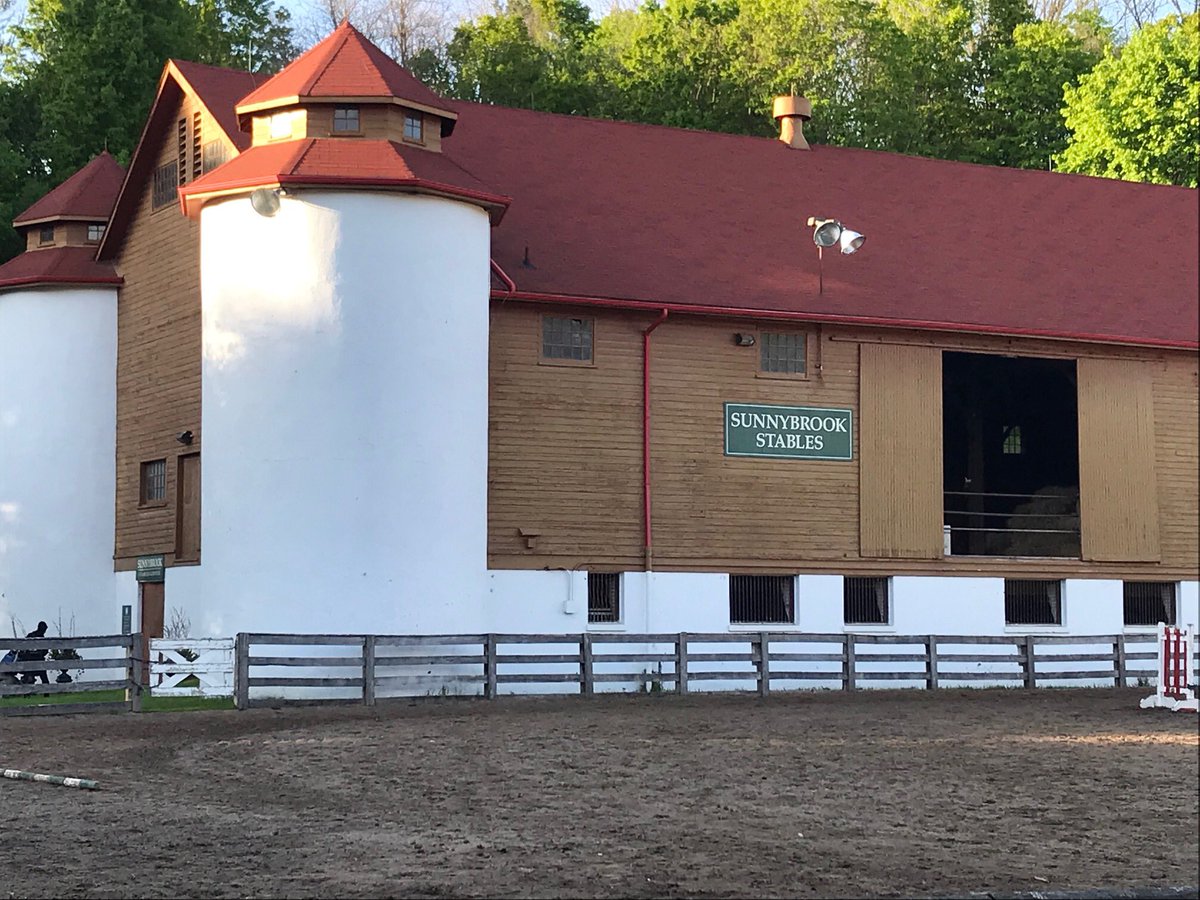
Sunnybrook Stables, a place where I taught beginner riders a couple of days a week, in a park in the heart of Toronto, burnt to the ground early that morning, trapping 16 of my good friends inside with no hope of escape.
Here’s what I wrote for The Rider, an Ontario-based equine newspaper.
HISTORIC TORONTO STABLE BURNS IN VICTORIA DAY FIRE
In the 21st century, horses and urban humans don’t often mix. But Toronto’s Sunnybrook Stables, located in the lush Sunnybrook Park at Leslie and Eglinton, gave inner-city kids (and adults) a chance to interact with horses and learn to ride. Along with its sister facility, the Riding Academy, located at Exhibition Place near the Lake Ontario waterfront, Sunnybrook offered a unique opportunity to Toronto’s urbanites: stables that can be reached by mass transit.
The two-alarm fire that destroyed Sunnybrook’s historic bank barn in the wee hours of Victoria Day, May 21st, 2018, made international news. Quick action by Toronto firefighters and police, who were summoned after an observer in a nearby apartment complex saw the flames, saved the newer barn which adjoins Sunnybrook’s indoor arena, and the 13 horses inside. The Toronto Police Mounted Unit swiftly mobilized their own trailers to relocate the survivors to the stables at the Horse Palace. Sixteen school horses, however, lost their lives in the fire, which totally consumed the bank barn.
The barn, which was built around 1910 as part of the estate of Major Joseph Kilgour, and was donated to the city of Toronto in 1928, became part of Sunnybrook Park, an urban oasis of trees, trails, picnic grounds, soccer fields … and a riding school.
Walter Shanly founded Sunnybrook Stables Ltd. in 1979, leasing the facility from the city. Shanly passed away in September 2017, and his widow, Jacquelynn, now operates the school.
The cause of the fire has yet to be determined. It is not considered to have been suspicious, despite the rumoured presence of individuals setting off fireworks in the park that evening.
At this time, with future plans for rebuilding uncertain, Sunnybrook Stables has asked that fund-raising be put on hold. If you wish to make a contribution, they suggest Greenhawk gift cards, which can be used towards replacing the lost tack for the surviving horses. A permanent memorial for the horses, in the park, is in the planning stages.
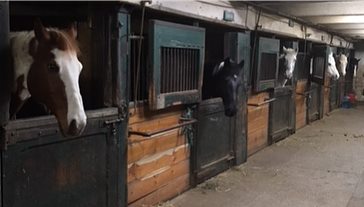
When a privately-owned horse passes away, those closest to that animal grieve, of course. But the school horses at Sunnybrook were known, and loved, by literally thousands of Torontonians, each with their own special memories of a favourite horse or pony. Some of the Sunnybrook mounts had been resident in the park for upwards of 20 years. The outpouring of sorrow on social media has been overwhelming, as have been the offers of funds, supplies, and green field time for the survivors.
I only had 1000 words to work with for the story, and I included a very brief description of each of the schoolies who were my work partners and my friends. I could easily have written a thousand words on each of them. So here, where no-one’s policing my wordcount, I thought I’d say a little more, so that they are not forgotten.
Sugar – one of Sunnybrook’s beginner specialists, Sugar was a red roan mare with a dished face and a big blaze. Her history as a Western pleasure mount gave her a super-slow trot and a rocking-chair canter, perfect for nervous riders. She had a sensitive mouth, which taught her young charges an important element of empathy.
Axel – a chestnut paint gelding, narrow and long-backed. A legendary grouch in the barn, Axel had to be caught in his stall by the staff, as he’d turn his butt and threaten to kick kids who entered his stall. But he was a surprisingly willing partner for Sunnybrook’s intermediate riders in the arena, giving them just enough challenge without ever verging on unsafe. He really shone over fences.
Sampson – one of the barn’s newer recruits, a cheeky black-and-white large pony who was a little green. He provided a nice challenge for the school’s more advanced riders, as he could get a little on the muscle — a change from the horses they had to kick to get moving.
Sandy – a little Appaloosa pony mare who was winding down to retirement and only used lightly in the school. I’ll be honest: riding Sandy was like a free chiropractic adjustment: she was that uncomfortable. But those who loved her, loved her fiercely.
Sutherland – the absolutely indispensible “Sudsy”, a 20-something gray Percheron/Arab cross, was beginner-friendly but forward, which is a fairly rare combination. Sutherland had been at Sunnybrook so long that few remembered a time before him. Low to the ground but sturdy, he carried adults and tiny kids with equal aplomb. He wouldn’t bother heaving himself into the air over cross-rails and little verticals, preferring just to trot over them. The jumps had to reach a certain height before he’d make an effort. I loved him for that.
Hercules – a liver chestnut Welsh cross, Herc could shuffle in slow-motion or turn it up a notch. He would mess with his small riders by drifting off the rail into the middle of the ring to test their steering skills. I had to laugh at him. If you can learn to ride a pony well, you can ride anything.
Poomba – 12 hands of pure cheek! Flaxen chestnut Poomba, much prettier than the Disney warthog, would babysit to a degree, but he could also be a handful. Over fences, he was on springs, rocketing kids out of the saddle with his exuberance. He also had a wicked set of brakes.
Blossom – a black-and-white medium pony mare with a kind heart and enough quality to have not been out of place on the A circuit. She took exceptional care of the kids on her back and seldom displayed much pony-tude.
Apollo – of Pony of the Americas breeding, freckled Apollo was under 10, but behaved like a much more seasoned pony. We could always count on his level head — and we instructors thanked gawd for him sometimes.
Phoenix — one of Sunnybrook’s more recent recruits, Phoenix was a gray Arabian mare who had been there just under a year. Something of a nervous Nellie in the barn, she was surprisingly well-trained and confident under saddle. A fun ride for the more advanced kids.
Tess – a bay Quarter Horse mare with a downhill build, Tess played the grumpy mare card but was very well-schooled, with some fancy dressage moves in her repertoire. I sympathized with her lack of enthusiasm for ham-handed, bratty kids, and tried to make my students appreciate her as a hidden gem.
Misty – a red roan mare of predominantly QH breeding, with one split ear, Misty was goey, sensitive, and a little spooky, not for a beginner. She knew her stuff over fences, and was a favourite of the instructors as a mount for themselves.
Marty – a dark bay Thoroughbred mare who was a nice junior hunter before arthritic hocks slowed her down, Marty was also for the more advanced students. She defended her stall space like a barracuda, and gave students a taste of ‘more go than whoa’.
Gifford – Sunnybrook’s mini mascot, reputed to be about 38 years old, was adored by everyone.
Beau – an irreplaceable beginner hero, this big yellow Appaloosa gelding trucked around tiny children and large, awkward adults with equal equanimity. For a first taste of canter, you couldn’t do better than Beau, who went off instructor voice commands. On the list of horses who should be nominated for sainthood, Beau was near the top of the list.
Mr. T – another stalwart who had been at Sunnybrook almost longer than anyone could remember. T was an almost-black Clyde cross, with a dignified Roman nose and the kindest eyes you could imagine. The extra white hairs sprinkled around those eyes spoke to his long years of service. Thanks to his size, T was another kind soul who got riders both large and small hoisted on his back, and he was our go-to for anyone who was special-needs, because we could trust him to the ends of the earth. T never got grumpy about his lot as an uber-dependable beginner mount, and viewed the world with quiet bemusement. I will miss him most of all.
There’s one serving less of beet pulp soaking in the yellow bucket this morning. An empty halter, and an abandoned rainsheet, on a straw bale in the barn. Her absence is everywhere.
(That ought to be enough foreshadowing to induce you to stop here, gentle reader, if you don’t like stories that don’t end well.)
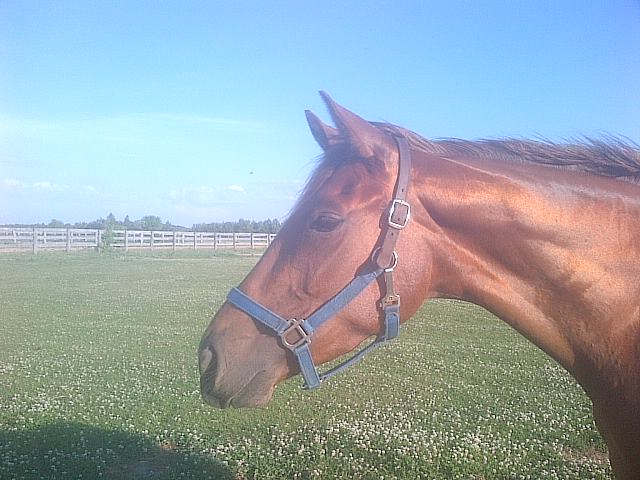
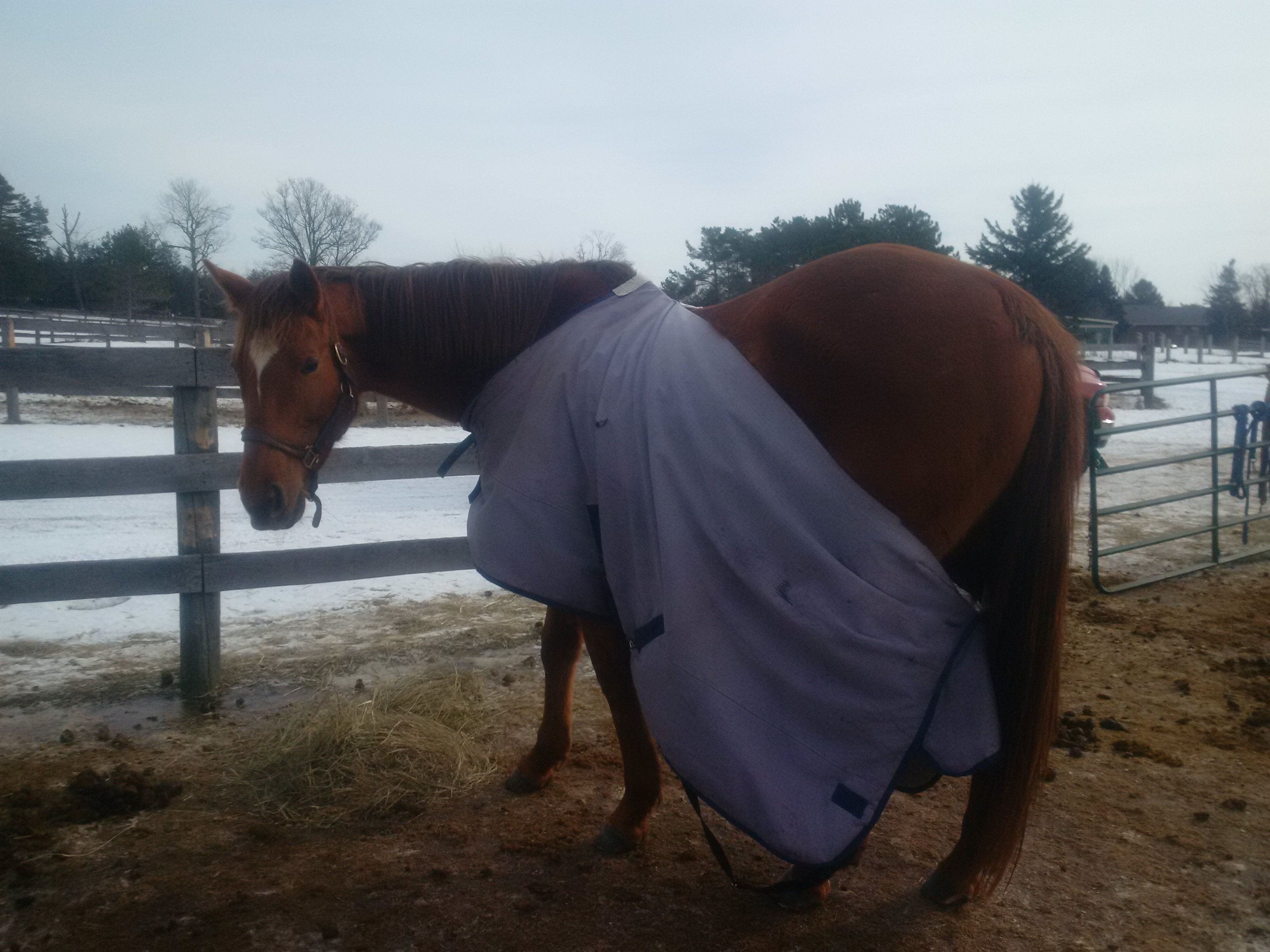
Trixie came to me as a freebie yearling, from a very nice, knowledgeable small breeder of Thoroughbreds. She was not destined for a racing career, so needed a home. She was nicely put together, and a lovely mover, but there were three strikes against her right from the start. One, she was congenitally swaybacked. Two, her dam — through no fault of her own, from what I could tell — had produced two or three other offspring who hadn’t made it to the races. (That usually makes buyers at a yearling sale hesitant to take a chance, especially on a filly with, um, unusual conformation, despite the fact that there have been several very successful racehorses who were swaybacked.)
And three, she was a chestnut Thoroughbred mare. That’s not a curse from a racing point of view, but certainly something of a hindrance in the sport horse world, where there’s a widespread belief that chestnut mares are … well, legendarily squirrelly.
With then-two-year-old Parker on stall rest with a hind ankle injury, I was looking for a project. I was thinking of a three- or four-year-old off the track, but when Trixie came along, I thought, well, a yearling is a clean slate, and that could be a very good thing. I did do my research on swaybacks before I agreed to take her: though it’s a saddle-fitting challenge, it’s not actually an unsoundness, and most congenitally swaybacked horses are just as sound and capable as those whose vertebrae are more conventionally designed. Plus, I admit, I thought she might grow out of some of it; they don’t call them ‘yaklings’ for nothing, and many an ugly duckling at 15 months turns out to be a stunning specimen later. (She didn’t grow out of it, but that was okay.)
The chestnut mare thing didn’t scare me particularly either. My horse of a lifetime was a copper chestnut with chrome. I’ve worked with a lot of chestnut mares, and I like their feistiness. But in all honesty, Trixie turned out to be every bad cliché of a chestnut Thoroughbred mare, ever, temperament-wise. That assumption has to come from somewhere, after all.
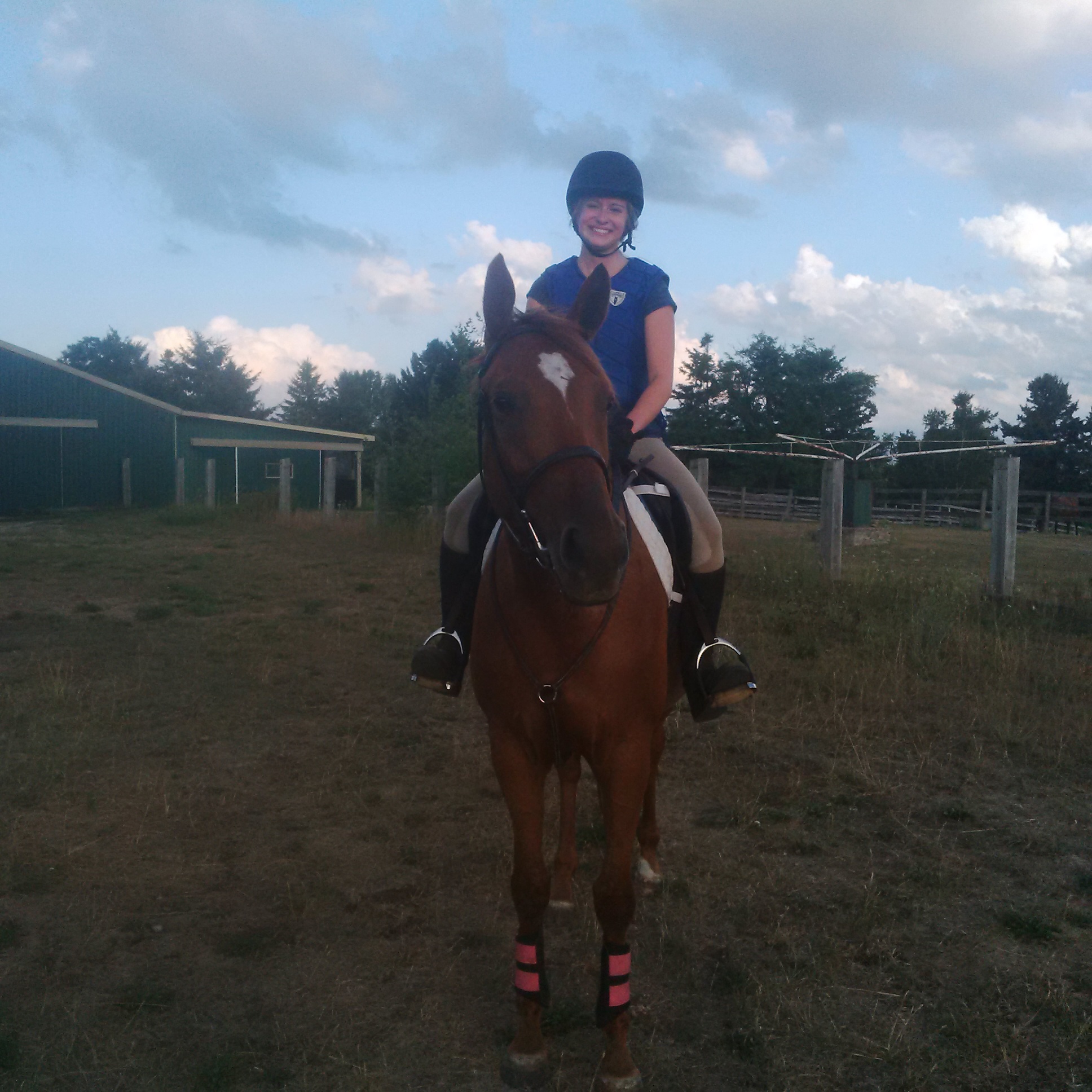
Trixie was a skittish little thing when she first came home to me, but I initially chalked that up to her having not had a lot of handling; when it became clear she wasn’t a candidate for the fall yearling sale, she stayed out in the field while her compatriots were brought in and given a crash course on being haltered, groomed, led, and otherwise fondled and harassed by humans. I started to work a little at a time on her ground manners. It took months before I could safely pick up her hind feet, and I never did get her to cross-tie reliably. Unfortunately, the flightiness she exhibited as a yearling never really went away. It was progress by centimetres with her, with just about everything; she was quick to panic, and when her fearfulness took over, her brain shut down. She did learn new skills, but because her panic button was so hair-trigger, it seemed to take her far longer than average to assimilate information, and she had more trouble retaining that information than most, too. The typical horse, after some time off, picks up right where she left off in her training, but Trixie always regressed to square one, so I would have to repeat the same lessons over and over. I wonder now whether she didn’t have a bona fide learning disability. She behaved in some ways like a horse who had been abused, but I knew for a fact that she never had been.
But when she wasn’t a hazard to herself and others because she was freaking out, Trixie could be a terribly sweet soul. There was no malice in her; she never meant to hurt anyone, and if she was feeling confident she would be the first to approach you, lick your hand, and ask for wither scritches. My student, Sarah Bernath, who’s in the photos above, fell in love with her gentle side, and was the first person on her back — a development which took far longer than usual for a young horse, given the amount of time it took for Trixie to accept wearing a saddle and bridle, and learn to longe without resembling a 1200 lb. orange marlin on a hook. In Trixie’s universe, there were lions, tigers, and bears in every corner, and a pole on the ground was cause for hysteria…. every. Single. Time.
And then, of course, there was the challenge of fitting her saddle. That took some experimentation. She not only was swaybacked but also had massive shoulder-blades, so she was a seriously weird shape. I tried a number of ways of filling in the hollow in the middle of her back to prevent a saddle from bridging, finally settling on some customization of anEcoGoldhalf-pad that I was lucky enough to win in a little Facebook contest. When I received the pad in the mail, I noticed that it had openings on each side, with velcro closures; that meant that you could remove, replace, and move around the foam inserts inside. I contacted the company to ask whether they had other thicknesses of foam for the pad, and they very kindly sent me, without charge, all of the other inserts available for that shape of pad. With a bit of fiddling, I came up with a pad which was thinnest near the withers, thickest in the middle, and sort-of-medium thickness under the cantle. The saddle sat rather high on top of the resulting pad, but it sat level, and it seemed to work. (Many thanks again to EcoGold.)
Essentially, Trixie’s problem was not her back … it was what was between her ears. Though we did get her started under saddle, progress was always one step forward, five steps back; she remained volatile, untrustworthy, and uber-sensitive. She would stand to be mounted but lose her shit when a rider’s right leg touched her side in search of the stirrup. I’m a bit old and creaky to be ploughed into the ground repeatedly, so I relied on brave volunteers to get on her … and if they could ride out the first 90 seconds, then usually Trixie would take a breath and become willing to be piloted after that. We got as far as cantering her under saddle, a couple of times. But I gave up all hope of her ever becoming an event horse; she was simply too fearful. Athletically, she was more than capable — hell, she was by far the nicest mover of my gang of six. Mentally, however, she just didn’t have the tools. I decided I would be happy just to make her a productive citizen of any kind.
So I kept chipping away at her, in hopes that things would improve with maturity, despite the urging of my boyfriend to stop putting effort and energy into her. “What am I going to do, just relegate her to pasture potato and feed her till she’s 30?”, I said.
Some horses just seem to be born under a black cloud. In addition to all of her other challenges, Trixie’s tendency to shut her brain off at the slightest hint of stress, resulted in this (left), the winter before last. I had hung a new feed bucket on the fenceline of her field, since she was now turned out with her BFF, Vivian (a bay OTTB filly a year Trixie’s junior). I belatedly realized I had not taped the handles of said bucket, which all good Pony Clubbers know you must do to avoid horses getting their halters snagged on the bucket and panicking.
The electrical tape was up at the house. I went up to get it. 20 minutes is all it took. She got hooked on the bucket, freaked out, went through two fencelines, sliced the shit out of the front of her knee, and galloped in blind hysteria all over the property, leaving a trail of blood in the snow. The bucket eventually surrendered, and even more eventually Trixie was caught along with her BFF, but the knee needed stitching, and after that it was three weeks of frankly hellish stall rest, with her leg trussed up like a Christmas goose in an attempt to keep her from popping the stitching. Medicating her was a daily nightmare, and every-other-day bandage changes required sedation that didn’t always work. It healed beautifully in the end, but the whole event was kind of Trixie in a nutshell.
So I wasn’t surprised when, this past November, Trixie developed a persistent, but otherwise minor-looking, snotty nose. Just the one nostril. She’d had a similar bout of respiratory infection the previous fall, and it had cleared up on its own. This one didn’t. And while she was otherwise healthy, it began to influence her energy level; she just seemed a little subdued (which, given that it was Trixie, wasn’t an entirely unwelcome thing and I was loathe to mess with it at first, I admit!). Knowing what a gawdawful patient she was, I hesitated to consult my vet because I knew antibiotics would likely be prescribed. By January, though, I caved, and my worst fears were realized: the Rx was two weeks of twice-daily sulfa pills, which had to be dissolved in boiling water, mixed with baby food, and syringed into her mouth. Suffice to say it was a battle (Every. Single. Time.) and occasionally I lost.
So we went through 250 pills or so, some of which actually got into her (some is still decorating the walls of her stall), and still had a sinus infection. At this point, my vet recommended more aggressive treatment. Which is when we went down the rabbit hole. I should not have been surprised.
I don’t have any photos of my heavily-sedated Trixie with two holes drilled into her skull. It was fairly awful and I held her head, but had to look fixedly at the stall wall, lest I get tunnel vision. We irrigated the sinus directly with a pump and hose inserted into the holes. Water and crud and blood splattered everywhere and began to freeze to the stall floor. My vet introduced antibiotic into the sinus cavity, and we put her back on the sulfa as well. And a week later, we repeated the irrigation with a device that was not unlike a pressure washer. More crud came out, but the radiographs showed more had stayed in. We tried a second, long-acting injectable antibiotic. Couldn’t seem to get ahead of the infection. I think we irrigated it three times in total, each episode a little more miserable than the last. She would perk up for a day or two, and then the discharge would return. Somehow, the simple snotty nose had become something life-threatening. (And of course, the bill was starting to add up, too …)
And then the culture came back from the lab, showing that the infection in her sinus was fungal. Which meant that there was nothing more, medicinally, that we could throw at it.
The only other treatment option, at that point, was an invasive bone flap surgery which would have had to have been performed at the University of Guelph’s large animal hospital: open up a much larger hole in her skull to scrape out all the infectious material from her sinus. It would have been invasive, would require weeks of hospitalization, and would likely cost me $4000 to $6000.
If it had been any of my other horses, I would have found the money somehow. But any of my other horses would have tolerated the hospitalization and the treatment. I couldn’t see how Trixie was going to. Hell, I hadn’t even been able to successfully get her on a trailer, so even getting her to Guelph was a fantasy. And the kicker, according to my vet, was that when the infection was fungal, the success rate on this surgery wasn’t great. Often, the fungus found a way to come back.
So I cried. A fair bit. I had often joked that I needed a way out for this sweet, frustrating, troubled mare, that I could accept with a clear conscience. I didn’t really mean it. With all of her quirks, I still was very fond of her. And she was only seven, with years and years ahead of her. But there were no good answers at the bottom of the rabbit hole.On Trixie’s last day, towards the end of February, I did all the expected things: carrots, cookies, grooming, fussing. Took a chunk of hair from her tail. But Trixie wanted to hang with her BFF, out in the field, more than anything — she had spent a lot of time confined to her stall during treatment — so mostly I left her alone so she could do that.
She went down with better grace than she had done most things, and quietly breathed her last while I shivered, standing watch. My vet was fantastically kind in making the arrangements.
And it’s taken me till now to complete this blog post about Trixie, because she broke my heart a little. I’ve had to put three horses down, now, in the seven years I’ve been at this farm, and that is just too fucking many. And to some extent I squirm at all the animal memorials all over social media; I didn’t want to inflict my sadness on everyone. But at the same time, I don’t want the life of this horse to have been absolutely unacknowledged. Only a handful of people met her, and even fewer loved her — just me, and Sarah, really (and Vivian, who is soldiering on). She was a hard mare to love. But she was here, and she was real, if only for an ill-fated few years.
I gave her her registered name, which was Mexican Wine, after the Fountains of Wayne song. It’s a fatalistic little tune.




 I kind of hate all Christmas music anyway. 99% of it is drivel that we would never be caught dead listening to at any other time of year. At best it has a lovely melody (O Holy Night comes to mind) but (atheist POV here) creepy or ridiculous lyrics that leave me conflicted; at worst, it’s trite, clichéd, and annoying AF. By December 25th, honestly, the thing I am most looking forward to is that the fucking music is gonna stop by the end of the day.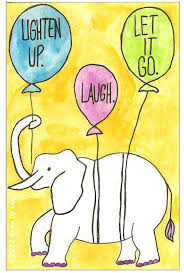
 straightforward choices about our sexuality without being hoist by our own petards is frankly ridiculous — and yet, here we are, still being judged as either frigid or sluts, depending on our answer to a proposition. If we say yes, without a whole bunch of token protests à la the song, then we’re nymphos, but if we say no we don’t really mean it and we’ll inevitably cave under pressure? Oh, wait, and then after we cave under pressure, men don’t respect us anymore. There’s just something utterly unpalatable about all of that patriarchal shit, and it makes me see red because, apparently, there’s a huge segment of the population which never wants to see that change.
 This is not a non sequitur: In 1946, Disney put out a movie called
 being run out of the main campus (which on an academic level, is far better equipped, but which lacks the equine facilities we have here in Clinton). To some degree (no pun intended)
 of course).
 find myself given the ‘here’s your hat and what’s your hurry’ come spring … and that could definitely happen. Moving everything, in my case, doesn’t just mean the contents of my little house … it also means five horses, two hay feeders, six rubber mats, five troughs, whothefuckknows how many jumps, multiple feed bins, six huge Rubbermaid containers just of blankets and rainsheets, the contents of an entire tack room, and two trailers. Bit daunting, that.
 arrrggghhhhh. I have lots of helpful people who’ve been keeping their ears to the ground for me, but suitable spots are proving elusive.



 also to realize that, as a result of that, I can for the first time in years indulge myself in one or two tiny things that I’ve been putting off buying pretty much forever. Nothing big — just stuff like a pot of Clinique moisturizer for my increasingly crinkly face. A new external hard drive (two terrabytes and it’s smaller than my phone … whoa). A couple of CDs that have been on my
 situation where your boss royally fucked you over and how you handled that?”), for which I was grateful. I got the nickel tour of the farm — which incidentally is very clandestine, tucked away in a suburb the other side of Hamilton with no signs or indications of any kind that it is a government facility — and then I went back into the city and took myself to see


 wanted to win this one. Later on he was just waiting in his starting gate with the other horses, when he saw a train go by. Jerry was in it and he ran to the caboose of the train to watch the race. Flash was in third place on the final turn and Jerry was on top of the rail waiting to see what would happen. All of a sudden the train started moving, sending Jerry flying off the back of the train. When Flash saw this, he bounced the driver off his sulky, snapping the reins and once free he ran over to get Jerry. He hopped the fence and started running and flung Jerry up on his back, following the train. In 5 minutes the train had reached the station and Flash was not far behind. He ran as fast as he cold and 2 minutes later he was there. Sensing Jerry was barely conscious, Flash tried to find his parents. It did not take him long. Flash saw two people looking panicked. Mom and Dad saw Jerry and ran over to get their son. They rushed him to a hospital and the following day Jerry came back out thanking Flash for saving him. Flash went back to his ranch and even though he didn’t win, he still felt like he did and Jerry went over to the ranch everyday to see Flash from that day on. Best friends.
 When a privately-owned horse passes away, those closest to that animal grieve, of course. But the school horses at Sunnybrook were known, and loved, by literally thousands of Torontonians, each with their own special memories of a favourite horse or pony. Some of the Sunnybrook mounts had been resident in the park for upwards of 20

 hadn’t made it to the races. (That usually makes buyers at a yearling sale hesitant to take a chance, especially on a filly with, um, unusual conformation, despite the fact that there have been several very successful racehorses who were swaybacked.)
 away. It was progress by centimetres with her, with just about everything; she was quick to panic, and when her fearfulness took over, her brain shut down. She did learn new skills, but because her panic button was so hair-trigger, it seemed to take her far longer than average to assimilate information, and she had more trouble retaining that information than most, too. The typical horse, after some time off, picks up right where she left off in her training, but Trixie always regressed to square one, so I would have to repeat the same lessons over and over. I wonder now whether she didn’t have a bona fide learning disability. She behaved in some ways like a horse who had been abused, but I knew for a fact that she never had been.
 And then, of course, there was the challenge of fitting her saddle. That took some experimentation. She not only was swaybacked but also had massive shoulder-blades, so she was a seriously weird shape. I tried a number of ways of filling in the hollow in the middle of her back to prevent a saddle from bridging, finally settling on some customization of an
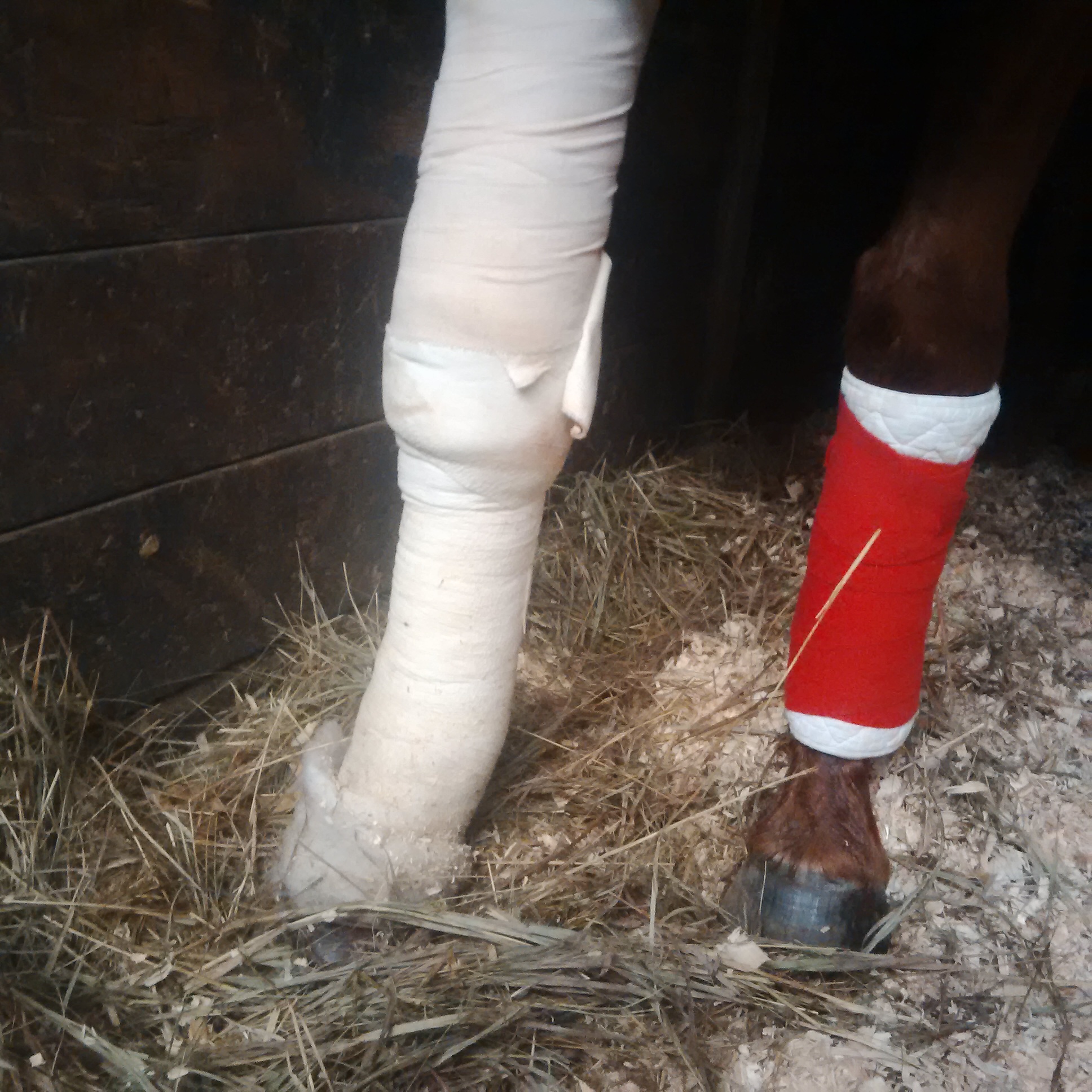 Some horses just seem to be born under a black cloud. In addition to all of her other challenges, Trixie’s tendency to shut her brain off at the slightest hint of stress, resulted in this (left), the winter before last. I had hung a new feed bucket on the fenceline of her field, since she was now turned out with her BFF, Vivian (a bay OTTB filly a year Trixie’s junior). I belatedly realized I had not taped the handles of said bucket, which all good Pony Clubbers know you must do to avoid horses getting their halters snagged on the bucket and panicking.
  And then the culture came back from the lab, showing that the infection in her sinus was fungal. Which meant that there was nothing more, medicinally, that we could throw at it.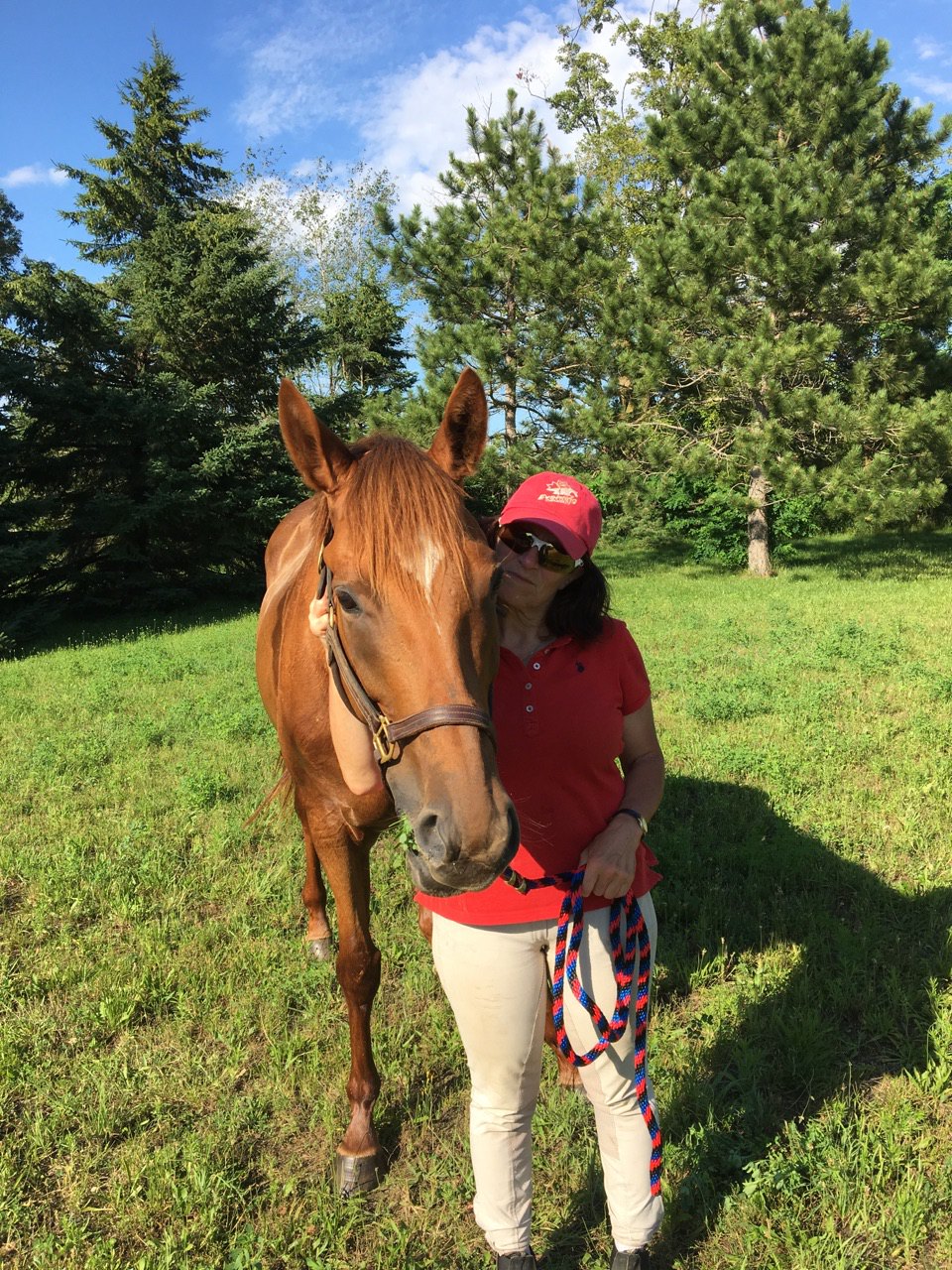


 Writing From the Right Side of the Stall